2025-02-28
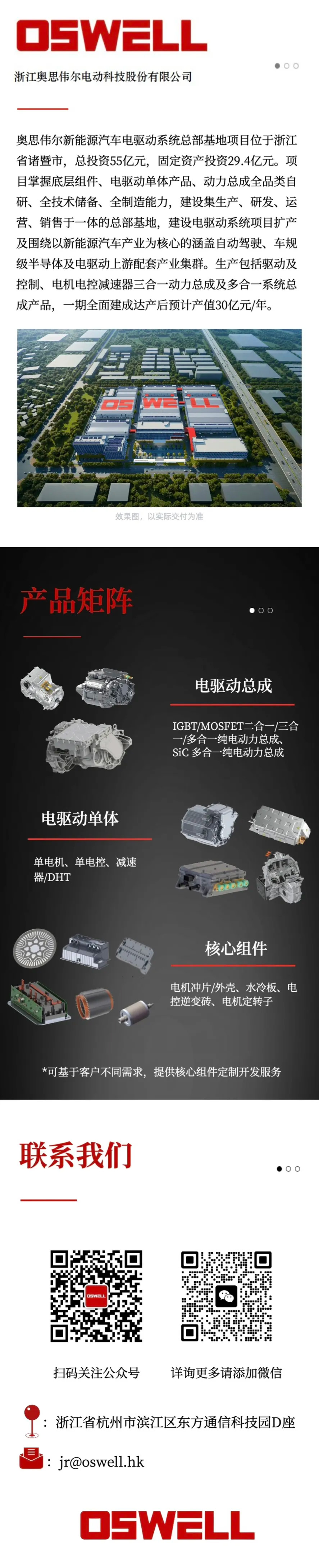
Amid the surge in new energy vehicles, Zhejiang Oswell Electric Technology Co., Ltd. is driving industrial transformation with technological innovation as its engine. Its headquarters project for new energy vehicle electric drive systems, located in Zhuji, Zhejiang, represents a total investment of 5.5 billion yuan and covers an area of 352.7 mu. Construction is currently accelerating, with full-scale production expected to commence in the third quarter of 2025. Although the headquarters has not yet been fully established, the company has already injected new momentum into China’s smart manufacturing through the ‘human-machine collaboration’ model on its existing production lines and continuous breakthroughs in research and development, becoming a vivid example of the development of new-quality productive forces.

Oswell’s electric drive production lines are not cold, fully automated environments, but rather a human-machine collaboration system centred on ‘intelligent equipment plus experienced technicians’. In key processes such as welding and assembly, intelligent operating equipment handles high-precision operations, ensuring the lowest possible error rate; whilst in stages requiring expert judgement—such as quality inspection and debugging—the technical team uses auxiliary systems to analyse equipment data in real time, ensuring a product pass rate of up to 99.5 per cent. This model harnesses the efficiency of intelligent equipment whilst retaining the flexibility and creativity of human labour, endowing the production line with the flexibility to rapidly adapt to different vehicle models.

Through the in-depth implementation of the ISO 9001 and IATF 16949 quality management systems, Oswell Co., Ltd. has innovatively introduced a ‘dual-track verification’ mechanism—cross-verifying data from equipment sensors with the results of manual spot checks—thereby establishing a unique ‘zero-defect’ assurance system. To date, this model has enabled the stable supply of over 250,000 drive modules to partners such as Geely Automobile.
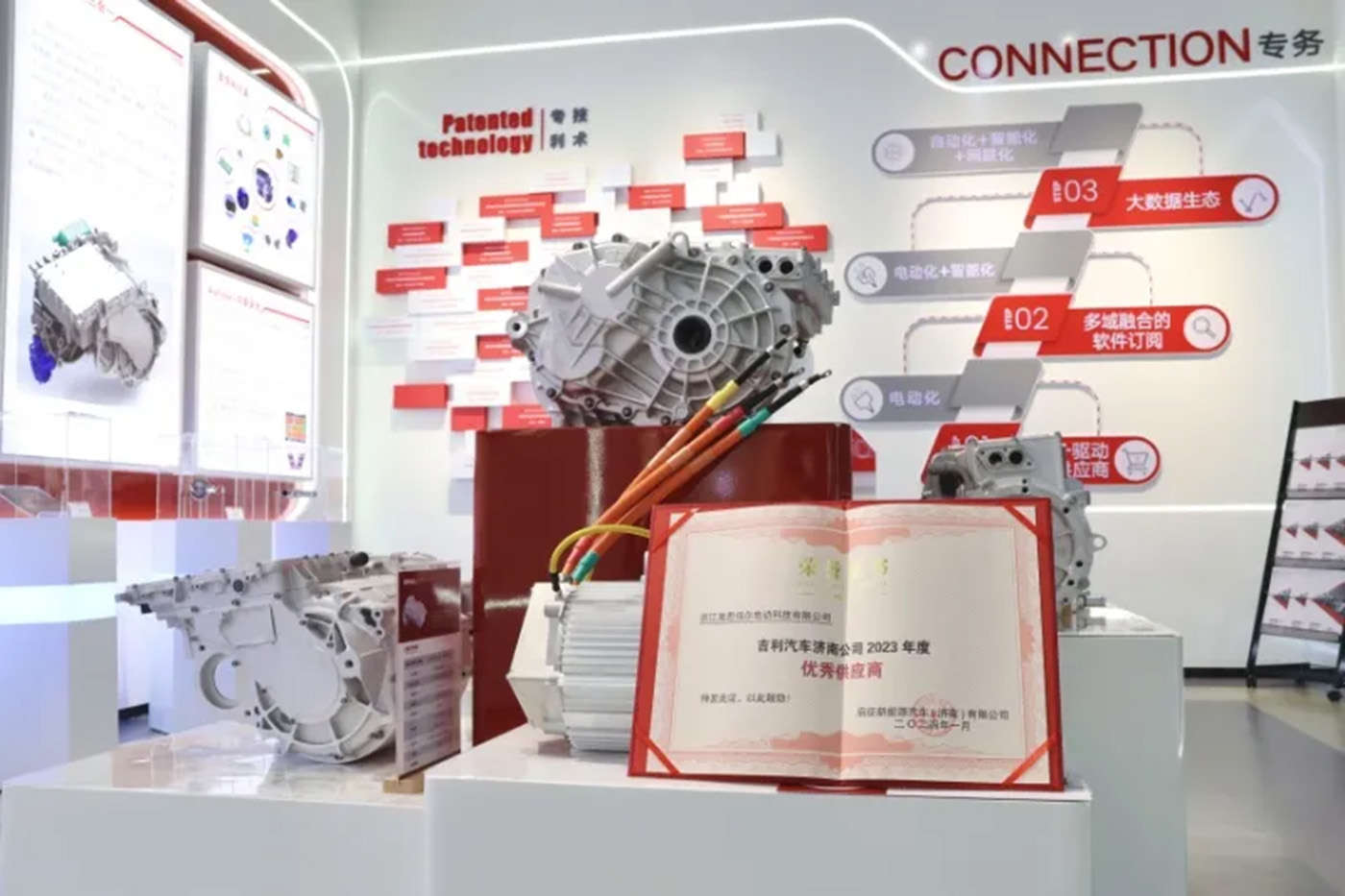

The essence of new-quality productive forces lies in talent-driven innovation. In recent years, Oswell Co., Ltd. has assembled a research and development team of over 100 people, 35 per cent of whom hold master’s degrees or higher, establishing comprehensive capabilities spanning the entire value chain—from motor design and control system development to process optimisation. This ‘technical elite’ has secured more than 40 national patents, including the ‘Vehicle-mounted Drive Module Assembly’ patent (CN111193419B). Their latest innovation, the air-cooled drive motor controller (CN116345992B), utilises a biomimetic heat dissipation structure that overcomes the limitations of traditional liquid cooling technology, maintaining power stability even in high-temperature environments and significantly enhancing the vehicle’s range.

The emergence of Oswell Co., Ltd.’s new patent demonstrates its forward-thinking approach to electric vehicle technology R&D and injects fresh vitality into the new energy vehicle market. This technology aligns with the current market trend of growing demand for environmentally friendly, energy-efficient electric vehicles. Industry experts note that the sector is at a critical juncture in its transition towards electrification and intelligentisation, and this patent for the air-cooled in-vehicle drive motor controller will provide even stronger technical support for competition in the electric vehicle market.

At present, Oswell Co., Ltd. has chosen to build its competitiveness through data-driven approaches. Its intelligent control system covers multiple key stages, from material intake to finished product dispatch, and by dynamically optimising production schedules, it has raised the comprehensive utilisation rate of equipment to over 90 per cent. Simultaneously, operational data from over 10,000 vehicles in the field is fed back into the R&D system, creating a flywheel effect of ‘market feedback – technological iteration – process upgrading’.

This ecosystem-oriented mindset is equally evident in supply chain collaboration. Oswell Co., Ltd. has partnered with its subsidiary, Wushao Semiconductor, to develop customised IGBT modules, taking a proactive approach to material innovation and chip packaging. Chairman Cao Guanhui once remarked: “We are building not merely production lines, but incubators for technological proliferation.”

Oswell’s experience demonstrates that new-quality productive forces are not merely about replacing human labour with machines, but rather the multiplicative effect of ‘talent density × technological innovation × in-depth application’. Through forward-looking investment in R&D and innovation in human-machine collaboration models, Oswell has significantly reduced energy consumption per unit of output and achieved a marked decrease in annual carbon dioxide emissions.

As the countdown to the commencement of operations at the Zhuji headquarters begins, a grander blueprint is unfolding—the future facility will integrate R&D, pilot production and mass production into a unified system, with an expected annual output of 2 million sets of electric drive and control system assemblies. This evolution from ‘incremental innovation’ to ‘disruptive breakthroughs’ may well serve as the finest illustration of the transformation and upgrading of China’s smart manufacturing sector.