2025-05-16
Currently, competition within the new energy vehicle industry is increasingly centred on cost and efficiency. Automakers’ requirements for powertrain systems have shifted from a focus on individual performance metrics to a dual upgrade encompassing integrated efficiency and scenario-specific adaptation. In response to these market changes, Oswell Co., Ltd. has long prioritised the research, development and upgrading of its powertrain products. Through modular design and deep integration, the company has specifically addressed three major pain points prevalent across the industry: excessive costs, poor compatibility and lengthy adaptation cycles, thereby helping automakers achieve more cost-effective electrification solutions.
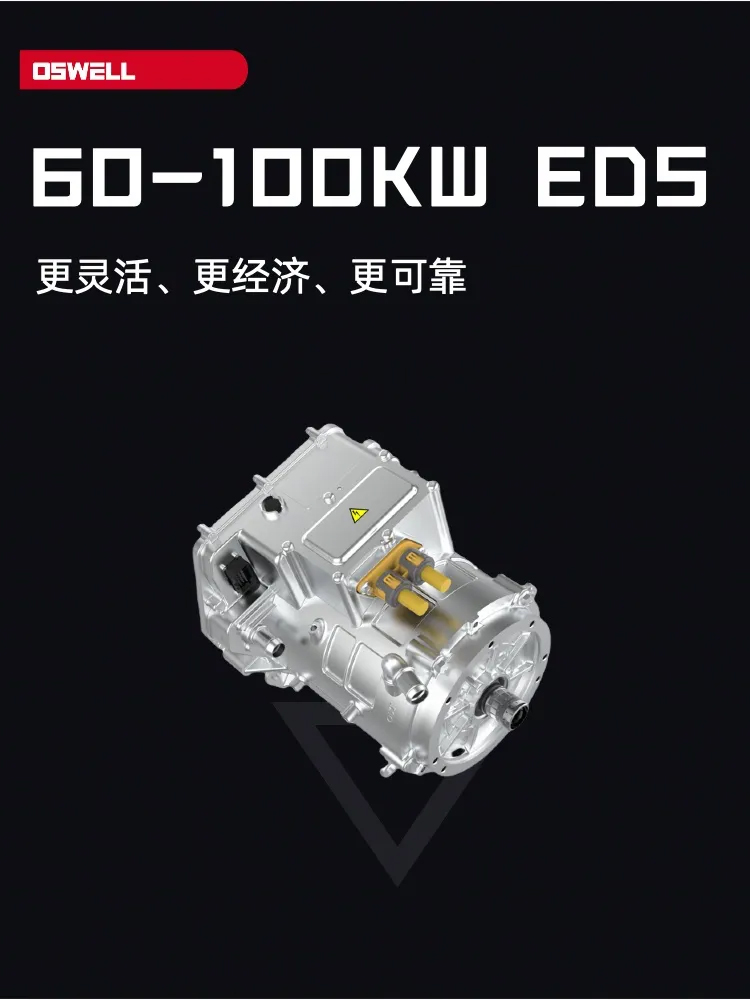
Traditional split-type motor and control unit configurations, due to their dispersed structure, suffer from issues such as redundant three-phase wiring harnesses, complex installation and high costs. With customer needs at the forefront, Oswell Co., Ltd. has launched a 60–100 kW integrated motor-and-control-unit powertrain product that directly addresses these industry pain points:
Simplifying the design to drive down costs
By eliminating the three-phase cables, controller brackets and bolts found in split-type layouts, and shortening the rotary encoder and temperature sensor harnesses, the number of components is reduced by over 10 per cent, directly lowering material and assembly costs;
Achieving both lightweight design and high power density
The integrated design reduces volume by 18% and weight by 15%, whilst boosting power density to an industry-leading 4.2 kW/kg, freeing up more space for vehicle layout;
Customised vibration-resistant design
To meet the demands of complex road conditions, a 10.9g vibration-resistant structure has been developed to ensure system stability under bumpy and impact-prone conditions, improving environmental adaptability by 30% and enabling the system to withstand the challenges of even the most demanding scenarios.
Oswell’s 2-in-1 electric drive assembly is not merely a simple physical integration, but a technological re-engineering based on a forward-engineering R&D platform, reshaping product value through four core highlights:
Zero-Redundancy Architecture: Cost Reduction and Efficiency Improvement
By eliminating the traditional independent electronic control layout, the three-phase wiring harness assembly and associated connectors are removed, reducing wiring length by 40% and saving over 200 yuan per system; The integrated housing design simultaneously optimises heat dissipation pathways, improving cooling efficiency by 15 per cent and further extending service life.
Flexible Platform, Versatile Adaptability
Through modular design, precise matching of torque output (220–240 Nm) can be achieved simply by adjusting the stator stack height, covering a range from passenger cars to commercial vehicles such as light trucks and microvans; standardised external interfaces support rapid installation by vehicle manufacturers, shortening vehicle model development cycles.
Process Innovation, Doubled Reliability
The use of flat wire winding technology increases slot fill rate by 30 per cent. Combined with a fully sealed housing and IP67 protection rating, the system’s lifespan exceeds 10 years or 400,000 kilometres. Backed by over 5,000 hours of bench testing and 200,000 kilometres of road testing, the failure rate is 20 per cent lower than the industry average.
Intelligent Compatibility, Future-Proof
Reserved CAN/LIN communication interfaces and OTA upgrade capability ensure compatibility with BMS and VCU protocols, whilst supporting 400V/800V high-voltage platforms, enabling automotive manufacturers to seamlessly transition to next-generation electronic and electrical architectures.
Designed for A0/A-segment pure-electric saloons, it delivers an ultra-high rotational speed of 12,000 rpm and peak torque of 240 Nm, achieving 0–50 km/h acceleration in 3.5 seconds to meet the demands of agile handling for urban commuting and long-range highway driving. For commercial vehicles such as microvans and light trucks, the ‘three-in-one electric drive axle’ integrated solution optimises low-speed high-torque output (220 Nm @ 0–3,000 rpm), enabling the vehicle to maintain a 30 per cent gradient whilst carrying a load of 1.5 tonnes, thereby helping to reduce costs and improve efficiency in logistics and transport.
Compared to split-type or low-integration products on the market, Oswell’s two-in-one powertrain offers the core advantages of ‘three increases and three reductions’:
Increased efficiency
The system’s overall efficiency reaches 93 per cent, with a 5–8 per cent improvement in range;
Enhanced Reliability
EMC Class 3 interference resistance and 10.9g vibration-resistant design ensure resilience in extreme operating conditions;
Enhanced Adaptability
Platform-based compatibility with over 10 vehicle models reduces R&D investment by 70%;
-
Reduced Space Requirements
Volume reduced by 18%, freeing up space for batteries or storage;
Reduced Weight
Lightweight design contributes to vehicle weight reduction and further optimises energy consumption;
Cost Reduction
Powertrain costs per vehicle reduced by over 15 per cent, enhancing automakers’ price competitiveness.
Seizing the future through integration. Oswell’s 60–100 kW integrated powertrain, built on a foundation of customer needs and utilising platform-based integration as its key strength, provides new energy vehicle manufacturers with solutions offering ‘higher performance, lower costs and faster deployment’.