2025-07-22

With the surge in energy density of new energy vehicle power batteries and the widespread adoption of 800V high-voltage platforms, by 2025, “thermal management” will no longer be merely a technical challenge—it will be a “lifeline” critical to vehicle performance, safety, and user trust. Traditional air-cooling solutions fall short under high-rate fast charging. Insufficient cooling efficiency—which leads to accelerated battery degradation and potential thermal runaway risks—has become a critical challenge that automakers must urgently address.
Battery Cooling: From Passive Cooling to Active Protection
Huating Power’s latest cooling components revolutionize traditional designs by embedding parallel, specialized heat-conducting tubes between adjacent battery layers; the material of these tubes has a melting point lower than the battery’s ignition point. During normal operation, coolant flows through the channels to dissipate heat; should a single battery cell catch fire, the channels automatically melt and release coolant to suppress heat propagation, combining heat dissipation and fire suppression into a single function. This “defensive cooling” design not only simplifies the manufacturing process but also keeps temperature variations within the battery pack within 5°C, directly extending battery life by more than 30%. (Sources: Sina, Oriental Finance, Longtong Network)
Extreme Cold Challenge: Multi-Circuit Coordination Breaks Through Low-Temperature Challenges
Nanfang Inte’s new patent directly addresses electric vehicles’ “low-temperature phobia.” Through the coordinated operation of a compressor, a three-way proportional valve, and an electronic expansion valve, the system automatically selects an initialization mode based on ambient temperature: at -30°C, it activates a dual-circuit heating mode to simultaneously warm the battery pack and the passenger compartment; by dynamically adjusting valve opening and compressor speed, it increases the battery pack’s heating rate by 40% within 30 seconds. This technology addresses the pain points of traditional thermal management systems—slow response and high energy consumption—in extremely cold environments. (Source: Sina, Oriental Finance)
Material Revolution: The Rise of Smart Thermal Conductive Media
A new generation of thermal management materials is emerging with four major trends:
Eco-Friendly: Biodegradable phase-change materials replace traditional chemical agents;
Functional Integration: A single material simultaneously provides thermal conductivity, insulation, and flame retardancy (e.g., graphene composites);
Shape Adaptability: Flexible thermal components accommodate the expansion and contraction of batteries during charging and discharging;
Smart Sensing: Embedded microsensors monitor temperature gradient changes in real time;
(Source: Internet)
It’s not hard to see that as battery cooling technology evolves at an accelerating pace, the core metric of modern thermal management systems has shifted from “cooling capacity” to “dynamic temperature control accuracy.”
Insufficient Efficiency = A Lifespan Killer:
For every 10°C increase in operating temperature, the rate of battery lifespan degradation doubles!
Uncontrolled Temperature Differences = A Hidden Time Bomb:
When the temperature difference between individual cells within a battery pack exceeds 5°C, the consequences are alarming—disparities in capacity degradation lead to a sudden drop in usable capacity; internal resistance imbalances trigger localized overheating and aging; and the probability of thermal runaway rises exponentially!
An ideal system must precisely maintain battery temperature within the optimal range of 25–35°C and strictly limit individual cell temperature differences to within the 3°C safety threshold—this is the non-negotiable baseline for ensuring battery safety, performance, and lifespan, and it is the true “lifeline.” (Data source: EV Resources)
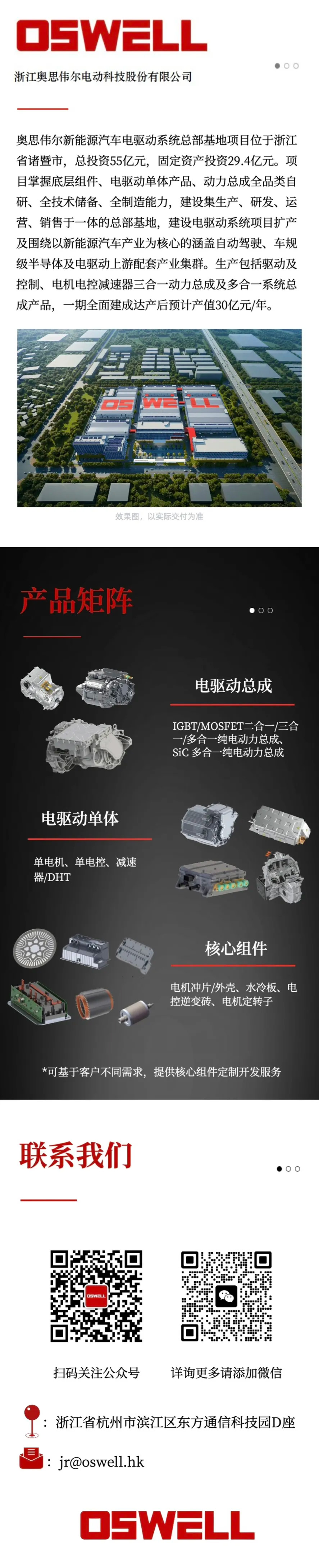
As one of the few domestic companies to have achieved fully in-house R&D and mass production of a three-in-one motor, electronic control unit, and gearbox system, Oswell Co., Ltd. has leveraged its deep mass-production experience and core technological expertise in the field of three-in-one electric drive systems (motor, electronic control unit, and gearbox) to develop a core control system compatible with cutting-edge thermal management solutions.
The reliability of the electronic control system’s own thermal management is a prerequisite for achieving precise battery thermal management. The patent for a compact, high-thermal-dissipation drive module—approved last year for Oswell Co., Ltd.—provides robust hardware-level thermal protection for the electronic control system through an innovative layout of ceramic heat spreaders and water-cooled radiators, ensuring the “smart brain” operates stably under high loads.
At the same time, the system can analyze motor operating data in real time to predict trends in thermal load changes in advance, providing proactive adjustment commands to the cooling system. This predictive capability significantly reduces temperature fluctuations and prevents temperature spikes caused by the “lagging response” of traditional solutions. Furthermore, the system overcomes the limitations of traditional modular control by integrating the control of the drive system with thermal management. It synchronously increases coolant flow during vehicle acceleration and automatically switches to a low-power cooling mode during energy recovery, thereby ensuring battery safety while optimizing the vehicle’s overall energy efficiency.
Oswell Co., Ltd. observes that over the next three years, the competitive focus of thermal management technology will shift from the performance of individual components to system-level energy efficiency optimization. Oswell will center its efforts on “component-level breakthroughs, system-level integration, and ecosystem-level collaboration” to enhance the industrial value chain, accelerate the domestic substitution of core components, establish thermal management domain controllers that integrate the battery, electric drive, and cabin systems, and build a “three-party collaborative development mechanism involving automakers, thermal management suppliers -component manufacturers,” and collaborate with upstream and downstream partners to build an innovation ecosystem. The company will provide customers with “one-stop technical adaptation” services to help shorten new vehicle development cycles, ensure synchronized technological upgrades of key components, and offer partners future-oriented drive solutions.